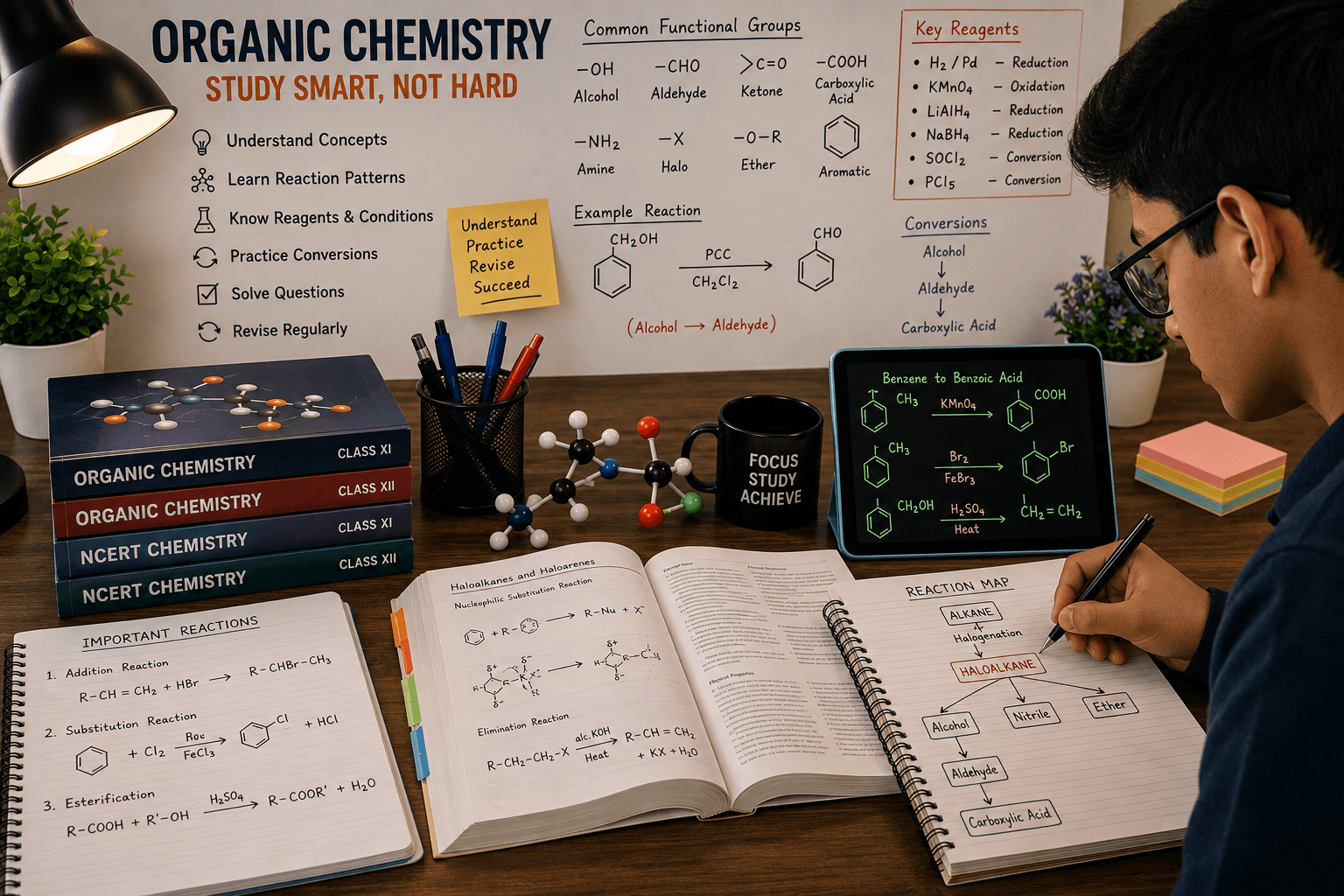
How to Study Organic Chemistry Without Rote Memorization
Organic Chemistry is often considered one of the most difficult parts of Chemistry.
Students see a large number of reactions and immediately think:
"I have to memorize all of this."
That's where the problem begins.
Organic Chemistry becomes much easier when you understand how compounds behave and why reactions occur instead of trying to memorize every reaction independently.
The goal should not be to remember hundreds of isolated reactions.
The goal should be to recognize patterns.
1. Start With Functional Groups
Before studying reactions, make sure you understand the major functional groups.
For example:
- Alcohol
- Aldehyde
- Ketone
- Carboxylic acid
- Ether
- Amine
- Haloalkane
- Alkene
- Alkyne
Understand the structure and basic properties of each group.
Once you know the functional group, many reactions become easier to organize.
2. Understand Reaction Patterns
Instead of memorizing:
Reaction A → Product A
and then separately:
Reaction B → Product B
try to understand the overall pattern.
Ask:
- What is the starting compound?
- What functional group is present?
- What reagent is being used?
- What changes during the reaction?
- What functional group is formed?
This approach helps you connect multiple reactions together.
3. Learn Reagents Properly
Don't memorize reagents as random chemical names.
Create a small reagent table.
For example:
ReagentCommon PurposeH₂/PdHydrogenationKMnO₄OxidationLiAlH₄ReductionNaBH₄ReductionH₂SO₄Acidic conditions / dehydration in suitable reactions
Always study the specific reaction conditions and context rather than assuming that a reagent behaves identically in every situation.
4. Understand Reaction Conditions
A reaction isn't only about reactants and products.
Conditions can be equally important.
Pay attention to:
- Temperature
- Catalyst
- Solvent
- Acidic/basic conditions
- Pressure
- Light where applicable
When writing your notes, place the reaction conditions clearly above or below the reaction arrow.
5. Build Reaction Maps
This is one of the most useful ways to study Organic Chemistry.
Instead of writing isolated reactions, connect compounds.
For example:
Alcohol
↓
Aldehyde / Ketone
↓
Carboxylic Acid
or
Alkene
↓
Alcohol
↓
Derivative
The exact reaction pathway depends on the compound and conditions, but thinking in terms of conversions helps you understand how different chapters connect.
6. Learn Mechanisms Where Required
A mechanism explains what happens during a reaction.
You don't need to turn every reaction into an advanced university-level mechanism.
But where your syllabus requires understanding the mechanism, don't simply memorize the final product.
Understand:
- Which bond breaks?
- Which bond forms?
- Which species attacks?
- What intermediate is formed?
- Why does the reaction proceed?
Understanding the process makes the final product easier to remember.
7. Practice Conversions
Conversions are excellent for testing your understanding.
For example:
Compound A → Compound B
Ask yourself:
- What functional group do I currently have?
- What functional group do I need?
- Which reaction can make that change?
- Which reagent provides that transformation?
- Are any special conditions required?
This is much better than guessing a reaction from memory.
8. Create a Reaction Notebook
Maintain a dedicated Organic Chemistry notebook.
Divide it into sections:
Functional Groups
Structures and properties.
Reagents
Important reagents and their common applications.
Name Reactions
Important reactions from your syllabus.
Conversions
Common conversion patterns.
Mistakes
Reactions and concepts you repeatedly forget.
This notebook becomes extremely valuable during revision.
9. Practice Questions Regularly
Reading reactions isn't enough.
After studying a topic, solve questions.
Start with basic questions and gradually move toward application-based problems.
Practice:
- Product prediction
- Reagent identification
- Conversion problems
- Reaction completion
- Mechanism-based questions
- Assertion/reasoning questions where applicable
The purpose of practice is to learn how to apply what you've studied.
10. Use NCERT Properly
For CBSE students, NCERT should remain an important part of preparation.
Read:
- Main concepts
- Reactions
- Examples
- Tables
- Exercises
- Important observations
Don't assume that only highlighted information matters.
Understanding the complete chapter gives you a stronger conceptual foundation.
11. Don't Make Extremely Long Notes
Your notes should help you revise.
They should not become another textbook.
For each reaction, try to capture:
Reactant → Reagent/Condition → Product
Then add a short explanation if necessary.
Use:
- Tables
- Flowcharts
- Reaction maps
- Short bullet points
- Highlighted exceptions
This makes revision much faster.
A Simple Organic Chemistry Study Method
Follow this sequence:
Step 1
Understand the functional group.
Step 2
Learn its important reactions.
Step 3
Understand the reagents and conditions.
Step 4
Practice conversions.
Step 5
Solve questions.
Step 6
Record mistakes.
Step 7
Revise the reaction map.
Repeat this process consistently.
Common Mistakes Students Make
Mistake 1: Memorizing Everything
Memorization without understanding quickly becomes confusing.
Mistake 2: Ignoring Reagents
Knowing the reactant and product isn't enough.
Mistake 3: Not Practicing Conversions
Conversion questions test whether you actually understand reactions.
Mistake 4: Skipping NCERT
For CBSE preparation, this can leave important concepts and reactions uncovered.
Mistake 5: Studying Only Before Exams
Organic Chemistry requires repeated exposure and revision.
Final Revision Strategy
Before an examination, revise in this order:
Functional Groups
↓
Important Reagents
↓
Reaction Maps
↓
Name Reactions
↓
Conversions
↓
Previous-Year Questions
↓
Mistake Notebook
This is much more efficient than rereading the entire chapter repeatedly.
Final Advice
Organic Chemistry isn't a collection of unrelated reactions.
It is a connected system of compounds, functional groups, reagents, transformations, and reaction patterns.
Instead of asking:
"How do I memorize this reaction?"
ask:
"Why does this reaction happen, and what transformation is taking place?"
That change in approach can make Organic Chemistry much easier to understand.
Understand the reaction. Understand the pattern. Then practice it.
Learn Chemistry the Conceptual Way.