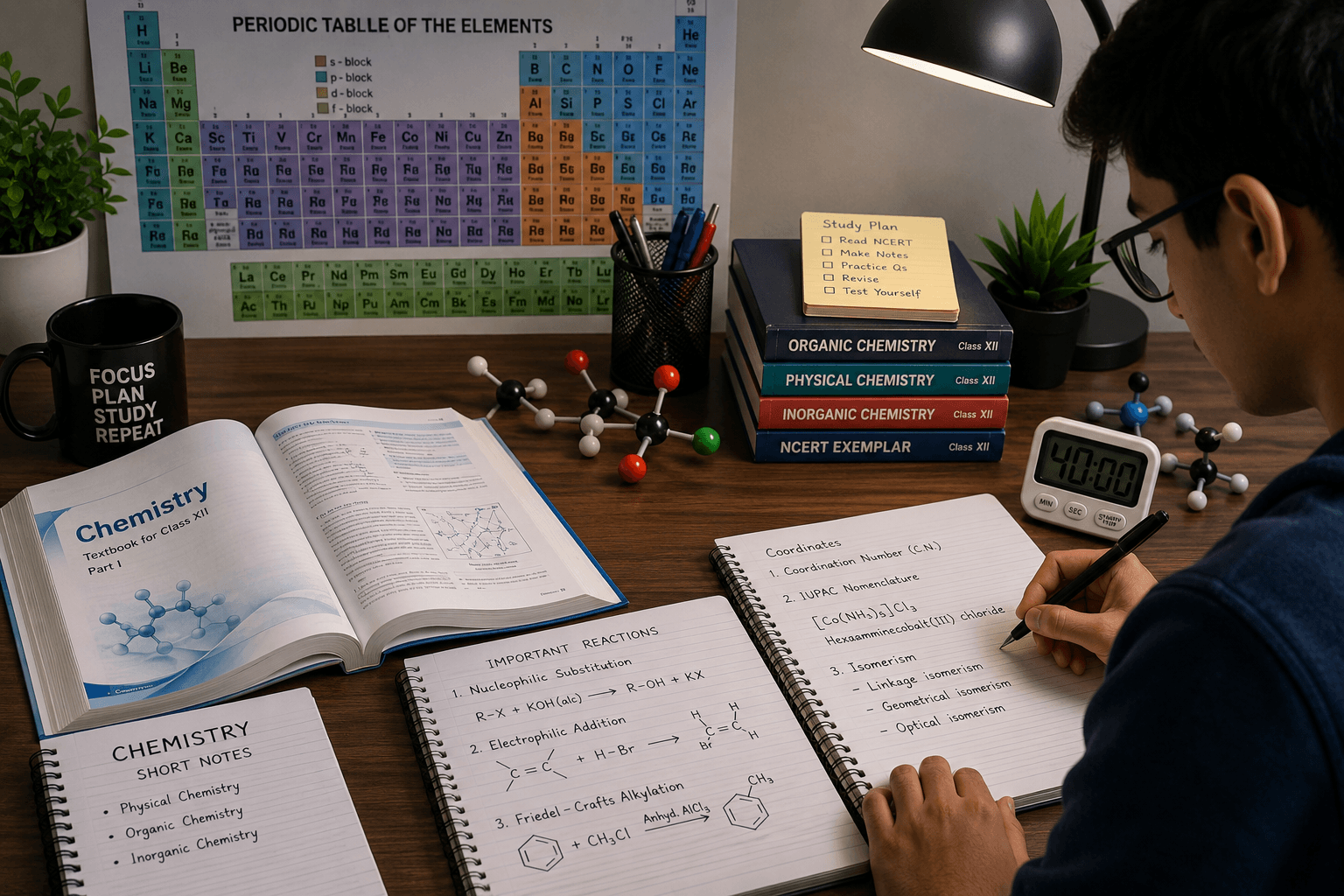
Why NCERT Is Important for CBSE Chemistry Preparation ?
For CBSE Chemistry students, NCERT should be the foundation of preparation.
Many students make the mistake of collecting multiple reference books, question banks, PDFs, and online resources before thoroughly studying the book that is already prescribed in their curriculum.
More resources do not automatically mean better preparation.
What matters is how well you understand and revise the resources you use.
In this article, let's understand why NCERT is important and how you can use it effectively for Chemistry preparation.
1. NCERT Builds Your Conceptual Foundation
Chemistry is not simply a collection of formulas and reactions.
You need to understand:
- Why a reaction occurs
- How chemical properties change
- Why a particular formula is used
- How different concepts are connected
- What happens at the molecular level
NCERT provides the fundamental concepts required to build this understanding.
Instead of immediately searching for shortcuts, start by making sure the basic concept is clear.
2. Read NCERT Actively
There is a major difference between reading a chapter and studying a chapter.
When you read Chemistry, don't just move your eyes across the page.
Ask questions while studying:
- What is the main concept here?
- Is there a definition I need to understand?
- Is this reaction important?
- Why does this property change?
- Is there an example that explains the concept?
- Can I explain this topic without looking at the book?
This turns passive reading into active learning.
3. Pay Attention to Reactions
Chemistry students often try to memorize long lists of reactions.
Instead, organize reactions according to:
- Reactants
- Products
- Reagents
- Conditions
- Type of reaction
- Important observations
For Organic Chemistry especially, understanding the relationship between functional groups and reactions can make revision much easier.
4. Don't Skip Examples and Exercises
Students sometimes focus only on theory and ignore the questions provided in the chapter.
That's a mistake.
Examples and exercises help you test whether you actually understand the concept.
After completing a topic:
Read → Understand → Close the book → Solve → Check
If you cannot solve a question without looking at the solution, go back to the underlying concept rather than simply memorizing the answer.
5. Make Your Own Short Notes
You don't need to rewrite the entire NCERT textbook.
Your notes should contain information that helps you revise quickly.
For example:
Physical Chemistry
- Important formulas
- Units
- Conditions
- Numerical methods
- Common mistakes
Organic Chemistry
- Functional groups
- Important reactions
- Reagents
- Conversions
- Reaction conditions
Inorganic Chemistry
- Important properties
- Reactions
- Trends
- Exceptions
- Important compounds
The goal is quick revision, not creating another textbook.
6. Combine NCERT With Question Practice
Reading NCERT alone is not enough.
After studying a chapter, solve questions from different levels.
Start with:
NCERT questions
Then:
School-level questions
Then:
Previous-year questions
Finally:
Higher-level questions, especially if you are preparing for competitive examinations.
This progression helps you move from understanding to application.
7. Use NCERT During Revision
Don't wait until the final week before the examination to open NCERT again.
A better strategy is repeated revision.
For example:
First Revision
Revise the chapter after completing it.
Second Revision
Revise it after completing a few more chapters.
Third Revision
Revise during full-syllabus preparation.
Final Revision
Focus on important concepts, reactions, formulas, and mistakes.
Repeated revision makes recall faster and more reliable.
8. Don't Depend Completely on Reference Books
Reference books can be useful.
But collecting five different books without completing one properly usually creates confusion.
Your priority should be:
NCERT → Understanding → Practice → Previous-Year Questions → Additional Resources
Use reference material when you need deeper practice or additional questions—not as a replacement for understanding your core textbook.
9. Make a Chapter Checklist
After finishing every chapter, ask yourself:
- Have I read the complete chapter?
- Do I understand the major concepts?
- Can I explain the important reactions?
- Have I solved the exercises?
- Have I practiced numerical problems where applicable?
- Have I reviewed my mistakes?
- Have I attempted previous-year questions?
- Can I revise this chapter quickly?
If the answer is "no" to several questions, the chapter probably needs more work.
NCERT Study Method
A simple method you can follow is:
Step 1 — Read
Read the concept carefully.
Step 2 — Understand
Ask yourself why and how.
Step 3 — Make Short Notes
Write only the important information.
Step 4 — Practice
Solve questions without looking at solutions.
Step 5 — Review Mistakes
Understand why you made each mistake.
Step 6 — Revise
Return to the chapter regularly.
What About JEE and NEET?
For students preparing for JEE or NEET, NCERT remains an important foundation, particularly for building conceptual clarity and for areas where NCERT-based knowledge is directly relevant.
However, competitive examinations require more than simply reading NCERT.
You also need:
- Extensive question practice
- Previous-year questions
- Time management
- Numerical practice
- Application-based problems
- Regular mock tests
So think of NCERT as the foundation, not the entire preparation strategy.
Final Advice
Don't measure your preparation by the number of books you have completed.
Measure it by how well you can understand, recall, apply, and explain Chemistry concepts.
Start with NCERT.
Understand every chapter properly.
Practice questions.
Review your mistakes.
Then use additional resources where necessary.
A strong foundation makes advanced preparation much easier.
Don't study Chemistry just to remember the answer. Study it to understand why the answer is correct.
Learn Chemistry the Conceptual Way.