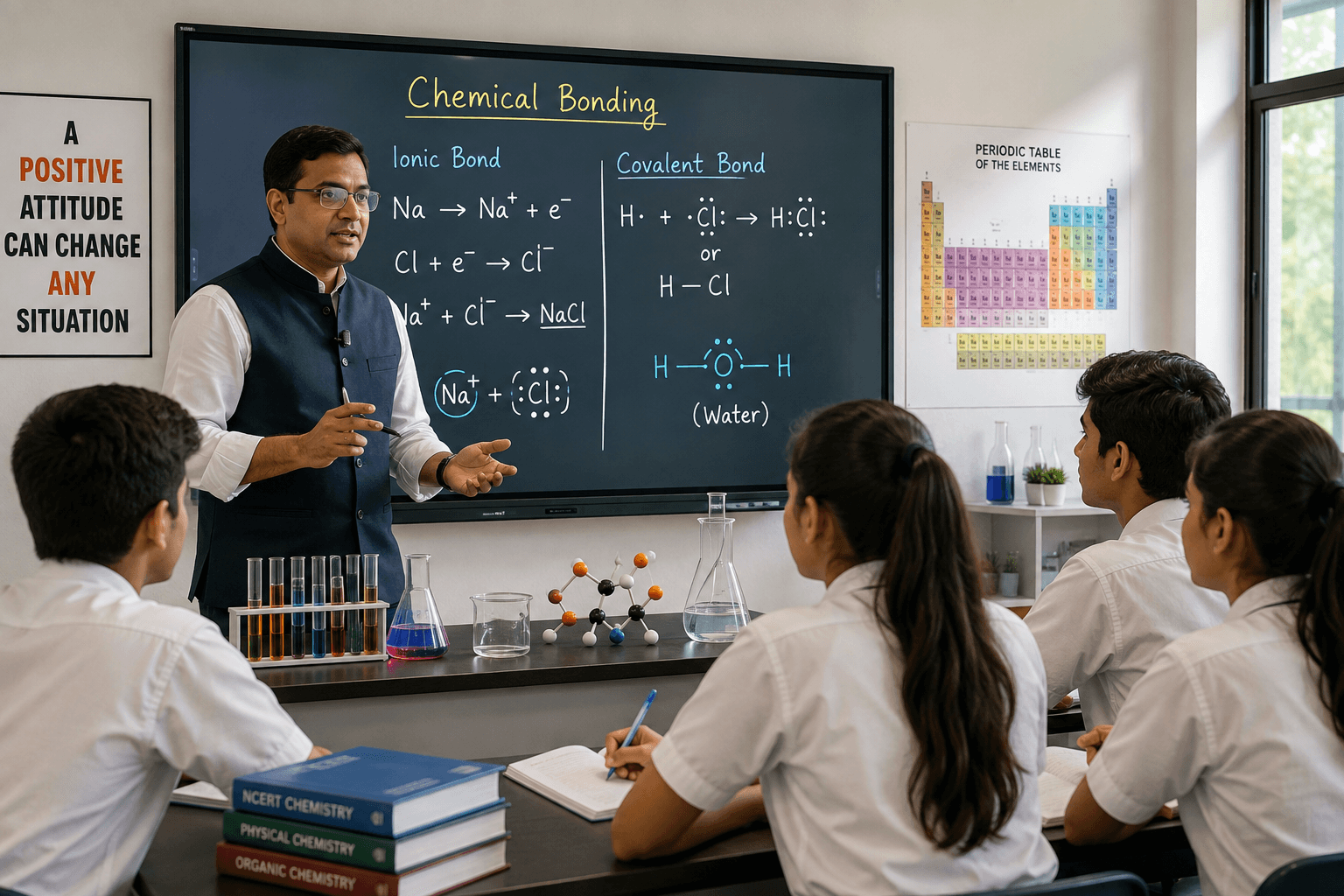
Class 12 Chemistry Preparation Strategy for CBSE Students
Class 12 is an important academic year, and Chemistry can become challenging when students try to complete the syllabus without a proper plan.
The solution isn't studying for extremely long hours.
The solution is studying the right things in the right order and revising them consistently.
A good Class 12 Chemistry strategy should combine:
Concepts + NCERT + Practice + Revision + Previous-Year Questions
Here's a practical approach you can follow.
1. Understand the Structure of Your Preparation
Don't treat the entire Chemistry syllabus as one large subject.
Divide your preparation into three broad areas:
Physical Chemistry
Focus on:
- Concepts
- Formulae
- Units
- Numerical problems
- Graphs and relationships
- Repeated practice
Organic Chemistry
Focus on:
- Functional groups
- Reactions
- Reagents
- Reaction conditions
- Conversions
- Mechanisms where applicable
Inorganic Chemistry
Focus on:
- Concepts
- Periodic trends
- Properties
- Reactions
- Exceptions
- NCERT-based information
Each area requires a slightly different study approach.
2. Start With NCERT
Your first priority should be understanding your NCERT Chemistry textbook.
Don't immediately jump between multiple reference books.
Read the chapter carefully and identify:
- Definitions
- Important concepts
- Reactions
- Examples
- Tables
- Diagrams
- Important observations
- Exercises
You can read more about this approach in our guide:
Why NCERT Is Important for CBSE Chemistry Preparation
3. Don't Try to Memorize Everything
One of the biggest mistakes students make is attempting to memorize Chemistry line by line.
Instead, ask:
What is the concept?
Why does this reaction happen?
What conditions are required?
How are these compounds related?
When should I use this formula?
Understanding the logic behind a concept makes revision considerably easier.
This is particularly important in Organic Chemistry.
4. Create a Chapter-Wise Study System
For every chapter, follow the same process.
Step 1 — Learn
Understand the concepts from NCERT and your teacher's explanation.
Step 2 — Make Short Notes
Record:
- Important concepts
- Formulae
- Reactions
- Exceptions
- Difficult points
Step 3 — Practice
Solve questions without immediately looking at the answer.
Step 4 — Check
Identify your mistakes.
Step 5 — Revise
Return to the chapter after a few days.
This creates a repeatable system instead of random studying.
5. Give Physical Chemistry Regular Practice
Physical Chemistry cannot be mastered simply by reading formulas.
You need to solve problems.
When solving a numerical:
- Write the given information.
- Identify what is required.
- Select the appropriate formula.
- Substitute the values carefully.
- Check the units.
- Verify whether the final answer makes sense.
If you repeatedly make calculation mistakes, maintain a separate numerical mistakes list.
6. Build a Reaction Notebook
For Organic and Inorganic Chemistry, maintain a dedicated reaction revision section.
Organize reactions by:
- Reactant
- Product
- Reagent
- Conditions
- Reaction type
Don't just write dozens of reactions on random pages.
Organized information is much easier to revise.
7. Practice Questions Immediately
Don't wait until you finish the complete syllabus before solving questions.
After completing each topic:
Learn → Practice → Analyze
If you make a mistake, don't simply memorize the correct answer.
Find the reason behind the mistake.
Was it:
- A conceptual error?
- A calculation error?
- A forgotten reaction?
- A misunderstanding of the question?
- A presentation problem?
This analysis is more valuable than simply counting how many questions you solved.
8. Use Previous-Year Questions
Previous-year questions are useful because they help you understand how concepts are tested.
After completing a chapter, solve relevant previous-year questions.
While solving, pay attention to:
- Repeated concepts
- Question patterns
- Numerical types
- Reaction-based questions
- Definitions
- Application-based questions
Don't memorize previous-year answers.
Understand the concepts that produced those questions.
9. Improve Your Answer Writing
Chemistry isn't only about knowing the answer.
You also need to present it clearly.
Practice:
- Correct chemical equations
- Proper balancing
- Correct units
- Appropriate conditions
- Clear diagrams
- Step-by-step numerical solutions
- Relevant terminology
Avoid writing unnecessary information that doesn't answer the question.
10. Don't Ignore Revision
Completing a chapter once doesn't mean you've learned it permanently.
Use spaced revision.
A simple approach:
Revision 1
A few days after completing the chapter.
Revision 2
After completing the next few chapters.
Revision 3
During full-syllabus preparation.
Revision 4
Before the examination.
Keep your final revision focused on:
- Formulae
- Reactions
- Important concepts
- Mistakes
- Previous-year questions
11. A Practical Weekly Routine
Here's one example of how you could divide your Chemistry preparation.
DayFocusMondayLearn a new conceptTuesdayContinue concept + NCERTWednesdayPractice questionsThursdayNumerical/reaction practiceFridayNCERT revisionSaturdayPrevious-year questionsSundayWeekly revision + self-test
You can adjust the schedule based on your other subjects and available study time.
The important thing is consistency.
12. Keep a Mistake Notebook
This is one of the most useful tools you can create.
Write down:
- Questions you got wrong
- Reactions you forgot
- Formula mistakes
- Calculation errors
- Concepts you misunderstood
- Questions you couldn't solve
Before an examination, revise this notebook regularly.
Your mistakes tell you exactly where your preparation needs improvement.
13. Don't Compare Your Study Hours
Studying for ten hours doesn't automatically mean you studied effectively.
Instead of asking:
"How many hours did I study?"
Ask:
"What did I understand today?"
A focused two-hour session can be more useful than several hours of distracted reading.
Quality matters.
14. Final-Month Strategy
When the examination is approaching, don't start collecting new books and resources.
Focus on:
NCERT
Your short notes
Important reactions
Formulae
Previous-year questions
Practice papers
Mistake notebook
The final stage should primarily be about revision and application, not constantly starting new material.
A Simple Chemistry Formula
Remember this approach:
Understand → Practice → Analyze → Revise → Test
Don't try to become perfect in one day.
Build your preparation chapter by chapter.
Final Advice
Class 12 Chemistry becomes much more manageable when preparation is systematic.
Start with NCERT.
Build strong concepts.
Practice regularly.
Maintain your mistakes.
Solve previous-year questions.
Revise repeatedly.
And most importantly, don't depend entirely on memorization.
Chemistry becomes easier when you understand the concepts behind it.
Learn Chemistry the Conceptual Way.