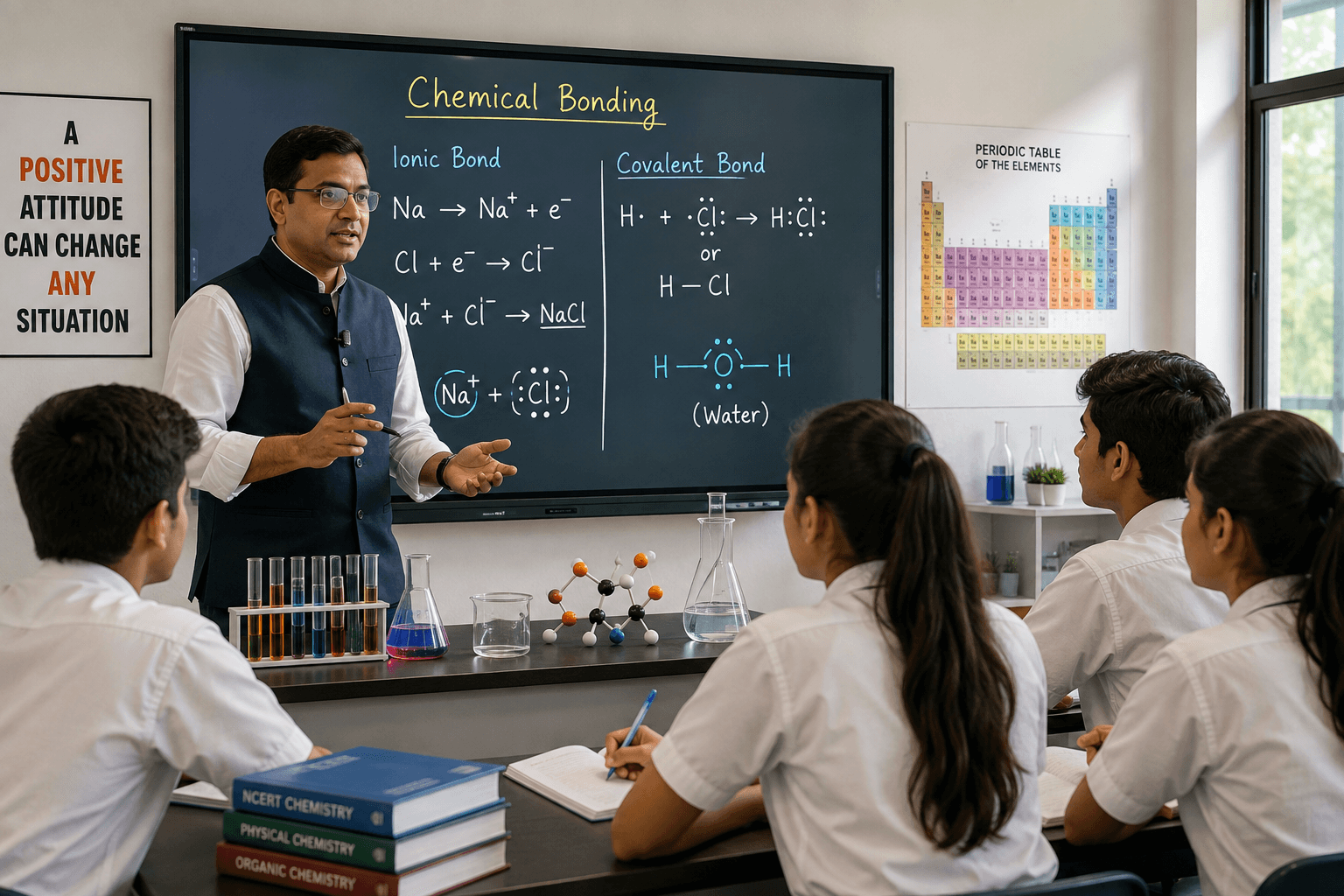
How to Study Chemistry Effectively for CBSE Board Exams
Chemistry is often considered a difficult subject because students try to memorize formulas, reactions, definitions, and concepts without understanding how they are connected.
The better approach is simple:
Understand the concept first. Practice it regularly. Revise it strategically.
With more than 15 years of teaching experience, I have seen that students usually struggle with Chemistry not because the subject is impossible, but because they use the wrong study method.
Here is a practical approach that can help CBSE students prepare more effectively.
1. Start With the Concept, Not the Answer
Before memorizing a reaction or formula, understand what it represents.
Ask yourself:
- Why does this reaction happen?
- What is changing?
- Which conditions are required?
- Why is this formula used?
- What does each term in the formula represent?
When you understand the reasoning behind a concept, remembering it becomes much easier.
Chemistry should be understood before it is memorized.
2. Make NCERT Your Foundation
For CBSE students, NCERT should be one of the most important resources in your preparation.
Read the chapter carefully instead of simply looking for important questions.
Pay attention to:
- Definitions
- Reactions
- Diagrams
- Tables
- Examples
- Important observations
- Exercises
- In-text questions
Don't skip paragraphs just because they don't look important.
Sometimes the simplest-looking line can help you understand an entire concept.
3. Divide Chemistry Into Three Parts
A useful way to organize your preparation is:
Physical Chemistry
Focus on:
- Concepts
- Formulas
- Units
- Numerical problems
- Step-by-step calculations
Don't simply memorize formulas. Understand when and why a formula should be used.
Organic Chemistry
Focus on:
- Functional groups
- Reaction patterns
- Reagents
- Reaction conditions
- Conversions
- Mechanisms where required
Instead of memorizing every reaction independently, try to understand how compounds are related.
Inorganic Chemistry
Focus on:
- Periodic trends
- Properties
- Reactions
- Exceptions
- Important compounds
- NCERT-based information
Regular revision is particularly important here.
4. Practice Every Day
Reading Chemistry for several hours once a week is less effective than studying it consistently.
Even 30–60 minutes of focused Chemistry practice every day can make a significant difference.
A simple routine can be:
20 minutes — Concept revision
20 minutes — Questions
20 minutes — Reactions or numerical practice
Adjust the duration according to your class and preparation level.
5. Solve Questions After Studying a Topic
Don't wait until the entire syllabus is completed before solving questions.
After finishing a topic:
- Close your book.
- Recall the important concepts.
- Solve questions without looking at the answer.
- Check your mistakes.
- Revise the concepts behind those mistakes.
This process helps you identify what you actually know rather than what you only recognize while reading.
6. Maintain a Mistake Notebook
This is one of the simplest study techniques that students often ignore.
Maintain a separate notebook for:
- Wrong answers
- Forgotten reactions
- Formula mistakes
- Calculation errors
- Important exceptions
- Concepts you repeatedly forget
Before an examination, revise this notebook instead of trying to reread the entire syllabus.
7. Practice Previous-Year Questions
Previous-year questions help you understand how concepts are tested.
While solving them, don't just check whether your answer is correct.
Ask:
"Why did I make this mistake?"
Classify your mistakes:
- Conceptual mistake
- Calculation mistake
- Memory mistake
- Question interpretation mistake
- Presentation mistake
Once you know the type of mistake, correcting it becomes much easier.
8. Improve Your Answer Presentation
Knowing the answer is only one part of scoring well.
Practice writing answers clearly.
For Chemistry:
- Write balanced equations correctly.
- Mention required conditions.
- Use appropriate units.
- Draw diagrams neatly where required.
- Highlight important points.
- Avoid unnecessary explanations.
- Use proper chemical terminology.
A well-structured answer is easier to read and evaluate.
9. Don't Leave Revision Until the Last Week
Last-minute preparation creates unnecessary pressure.
Instead, revise chapters multiple times.
A simple pattern can be:
First revision: Within a few days of learning.
Second revision: After completing the chapter.
Third revision: During full-syllabus preparation.
Final revision: Before the examination.
Repeated short revisions are generally more effective than one long revision session.
10. A Simple Weekly Chemistry Routine
You can structure your week like this:
DayFocusMondayLearn conceptsTuesdayPractice questionsWednesdayReactions/formulasThursdayNumerical problemsFridayNCERT revisionSaturdayPrevious-year questionsSundayWeekly revision and self-test
You don't have to follow this schedule exactly. The important thing is to maintain consistency.
Final Advice
Don't approach Chemistry as a subject that requires endless memorization.
Instead:
Understand → Practice → Revise → Test → Correct → Repeat
Build your fundamentals first. Use NCERT as your foundation, practice questions regularly, and keep track of your mistakes.
With consistent preparation and the right approach, Chemistry can become a much more manageable and interesting subject.
Learn Chemistry the Conceptual Way.